Stop App-Hopping: How a Modular Dashboard Saves Hours Every Week
The average person uses 9 apps daily. Each one demands a login, a different UI, and a context switch. Here's how consolidating into a single dashboard reclaims your time.
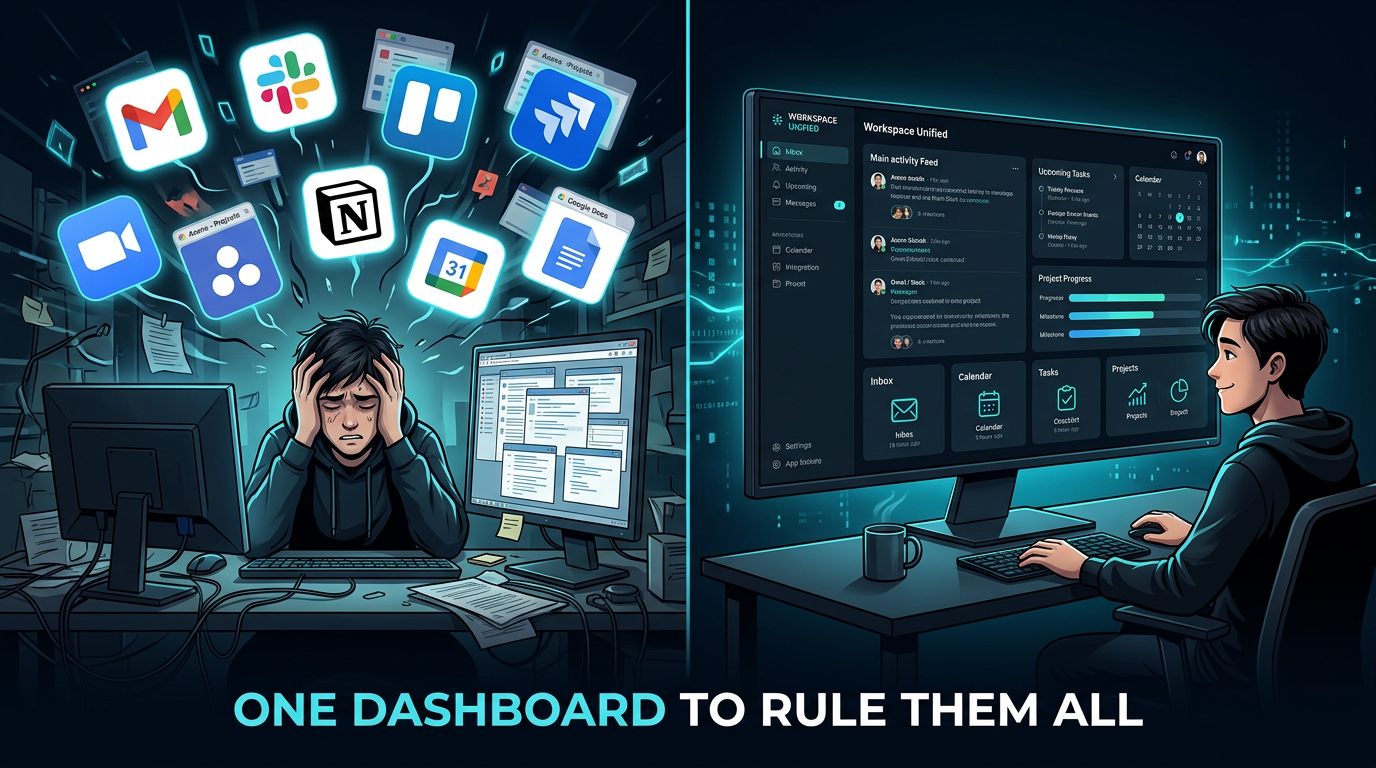
The average person uses nine different apps per day and thirty per month. Each app has its own login, its own design language, its own notification system, and its own idea of what "organized" means.
You didn't sign up for this. You signed up for a weather app, a to-do app, a calendar, a news reader, a finance tracker, a note-taking tool, a meal planner, and a habit tracker. What you got was nine different interfaces fighting for your attention.
The Real Cost of Nine Apps
It's not just the subscription fees — though those add up. It's the cognitive overhead:
- Nine different UIs to learn and remember
- Nine notification channels interrupting your day
- Nine data silos that don't talk to each other
- Nine logins to manage (or one password manager, which is another app)
- Nine places where your data lives, each with its own privacy policy
And the biggest cost: zero integration. Your calendar doesn't know about your tasks. Your tasks don't know about your goals. Your goals don't know about your habits. You become the integration layer, manually connecting dots across apps.
One Interface, Everything You Need
A modular dashboard collapses all of this into a single, consistent experience. Same design language. Same navigation patterns. Same data layer. You learn one interface and it serves every need.
Here's what that looks like in practice:
Monday morning, 7:15 AM. You open your dashboard. In one glance: it's 45°F and partly cloudy (no umbrella needed), you have three meetings today, your highest-priority task is the Q1 report due tomorrow, Bitcoin is up 3%, and your AI summary says "focus on the report — everything else is on track."
Compare that to the old way: open Weather app, open Google Calendar, open Todoist, open Coinbase, open Gmail, open Slack, open your project management tool. Twenty minutes gone before you've done anything.
Customization Without Complexity
The key is that modules snap in and out without friction. Going on vacation? Mute the work-related modules and surface the travel countdown, weather for your destination, and your bucket list. Starting a fitness journey? Add the Strava tracker, meal planner, and goals module. Tax season? Bring up the financial tracker and receipt notes.
Your dashboard evolves with your life instead of requiring you to hunt for new apps every time your needs change.
The Data Advantage
When everything is in one place, you get insights that siloed apps can never provide:
- "You've completed 80% of your tasks this week but none of them were tied to your Q1 goals"
- "Your grocery spending is up 30% — your meal planner has 5 unplanned restaurant meals this month"
- "You journal more consistently on days when you complete your morning SMITTI goal"
These cross-module insights emerge naturally when the data lives together. No CSV exports, no Zapier integrations, no manual tracking spreadsheets.
Making the Switch
You don't have to go cold turkey. Start with the three apps you open most often — for most people that's weather, calendar, and tasks. Set up those modules, use them for a week, and notice how much less you're context-switching.
Then add one module per week. Within a month, your dashboard is your entire morning routine in a single tab.
The hours you save aren't hypothetical. They're the twenty minutes every morning, the five minutes between meetings, the evening scroll through three apps to plan tomorrow. It adds up to hours per week — time you get back for the things that actually matter.